

Future-Proofing Your Organisation
Updated: Aug 21
The Case for Leadership Development Training and Coaching: A Research-Backed Guide for Senior Leaders and HR Professionals

The Urgency Has Never Been Greater
We are living through a period of unprecedented organisational disruption. Artificial intelligence is reshaping roles at every level, hybrid work has permanently altered how teams function, and demographic shifts are draining leadership pipelines faster than most organisations can replenish them.
Accelerating change, AI disruption, and rising expectations are reshaping what it takes to lead, demanding unprecedented agility from today's executives and managers. ~ DDI Global Leadership Forecast 2025
Against this backdrop, organisations face a stark choice: invest proactively in developing the leaders they need for tomorrow, or scramble reactively when capability gaps become crises. The research makes a compelling case for the former, yet a troubling gap persists between what organisations know they should do and what they actually deliver.
The Leadership Gap: A Crisis Hiding in Plain Sight
The data paints a concerning picture. DDI's Global Leadership Forecast 2025, spanning over 50 countries and 24 industry sectors, drawing on responses from 2,185 HR professionals and 10,796 leaders, found that 40% of stressed-out leaders have considered leaving their roles to improve their wellbeing, threatening a structural breakdown in leadership pipelines.
40% of leaders have considered leaving their roles to improve wellbeing
20% of HR leaders have successors ready for critical roles
80% of organisations lack confidence in their leadership pipeline
The talent pipeline itself is dangerously thin. While many CHROs rank internal talent development as their top priority, and 75% prioritise internal promotion, only 20% of HR leaders have successors ready for critical roles, and just 49% of key roles could be filled internally today. When organisations are forced into rushed external hiring decisions, they sacrifice institutional knowledge, culture continuity, and the return on the development investment they never made.
Compounding the pipeline problem is a generational shift of historic scale. By 2030, 55% of Baby Boomers are predicted to leave the workforce, creating a wave of leadership exits. And nearly half of executives (49%), say the skills their teams rely on today won't be relevant in two years (Torch, 2024).
The Performance Gap
Simply having a leadership development programme is not enough. Despite over 70% of organisations planning to increase their leadership development budgets in 2024, 83% of organisations still struggle to develop leaders at all levels, creating a significant gap between intention and execution (Executive Coach College, 2025).
Much of the investment in leadership development is still built around older approaches: short workshops, content-heavy programmes, and informal mentoring. These are helpful, but they rarely change behaviour in sustained ways.
What the Research Says Actually Works
1. Coaching as Infrastructure, Not a Perk
The shift from training to coaching represents one of the most important evolutions in leadership development. Deloitte's 2025 Global Human Capital Trends notes that, even as AI reshapes the manager role, capabilities like coaching and development are even more essential. Organisations are funding coaching programmes to help shift managers from task supervision to people development, a shift that reduces attrition and speeds adoption of new ways of working.
The return on investment is striking. According to a recent ICF study, 99% of people who received coaching services reported being satisfied or highly satisfied, and research conducted by leading consulting firms found that the ROI of a coaching engagement can exceed 500 times the initial investment. More broadly, research estimates approximately $7 returned for every $1 invested in leadership development.
Research estimates approximately $7 returned for every $1 invested in leadership development
Potential ROI of executive coaching engagement = 500x
2. Building a Leadership Factory, Not Just a Training Calendar
McKinsey's research on what distinguishes truly effective leadership organisations points to a systemic approach rather than episodic interventions. Organisations with successful leadership development programmes were eight times more likely than those with unsuccessful ones to have focused on leadership behaviours that executives believed were critical drivers of business performance.
McKinsey's research on 21st-century leadership identifies six critical traits for future leadership success:
• Positive energy, personal balance, and inspiration
• Servant and selfless leadership
• Continuous learning and a humble mindset
• Grit and resilience
• Levity
• Stewardship
Crucially, all leaders need to continually sharpen these traits, they are not fixed at appointment. The organisations that succeed are those that build structural, ongoing development into the fabric of how leadership works.
3. Succession Planning as a Strategic Imperative
Effective succession planning is not simply a risk management exercise, it is a direct driver of competitive performance. Organisations that grow leaders from within are 2.8 times more likely to outperform industry peers, and McKinsey reports that organisations with strong succession plans are 1.5 times more likely to outperform their competitors.
The urgency of proactive succession is underscored by retention data. High-potential individual contributors show a sharp rise in departure intentions: from 13% in 2020 to 21% in 2024, and these employees were nearly four times more likely to leave if their manager did not provide regular growth opportunities (DDI GLF, 2025).
The Great Resignation may be long gone, but more than half of CEOs rank talent recruitment and retention as their top concern for the next five years. ~ Tacy M. Byham, PhD, CEO of DDI
4. Emotional Intelligence as a Competitive Differentiator
Once dismissed as a soft skill, emotional intelligence (EQ) has been repositioned by recent research as a core leadership capability. The World Economic Forum's Future of Jobs Report 2025 listed emotional intelligence among the top skills required for the next five years, alongside analytical and social skills. A Harvard Business Review study found that leaders who demonstrate empathy and emotional insight significantly outperform their peers in overall effectiveness.
A Korn Ferry study found that self-aware leaders contribute to a 30% increase in organisational performance by leveraging their strengths. Developing leaders with strong self-awareness and emotional regulation is not just a wellness initiative, it is a retention and performance strategy.
5. Adaptive Leadership for a VUCA World
*(VUCA: Volatile, Uncertain, Complex, and Ambiguous)
Korn Ferry's Workforce 2025 Global Insights Report emphasises the growing need for leaders to be agile learners, inclusive visionaries, and tech-savvy innovators. Adaptability, collaboration, and authentic leadership are identified as key for leadership success, with adaptive leadership meaning the creation of an environment where quick, iterative decision-making is the norm.
Harvard Business Publishing's 2024 global leadership study, drawing on more than 1,100 L&D professionals and functional leaders across 14 countries, found that 70% say it is important or very important for leaders to master a wider range of effective leadership behaviours to meet current and future business needs.
6. Diversity in the Leadership Pipeline
Diversity is not only an equity imperative, it is a measurable performance driver. McKinsey's 'Diversity Wins' study shows that diverse executive teams outperform their peers financially by 36%. Yet leadership development programmes still have significant equity gaps to close: women are 12% less likely than men to receive leadership skills training, and formal mentorship programmes tailored to women have fallen from 45% in 2017 to 37% in 2024.
Diverse executive teams outperform their peers financially by 36%.
The Emerging Landscape: AI and the Future of Leadership Development
The delivery of leadership development itself is being transformed. AI-powered training improves skill acquisition by up to 20% over traditional methods, and AI-powered training tools have seen 40% annual growth in adoption.
Harvard Business Publishing's 2025 Global Leadership Development Study highlights that the mandate for L&D has fundamentally changed: the business is looking for fast, fluid, and future-focused learning. The velocity of organisational learning must be accelerated through a reciprocal exchange between AI and the people working alongside it.
At the same time, the most important challenges facing leaders remain deeply human. DDI's 2025 research found that frontline managers are three times more likely to have concerns about the impact of AI compared to their senior counterparts, and successful AI adoption requires cultural transformation and more empathetic leadership, not just technical literacy.
Future Proof Leaders
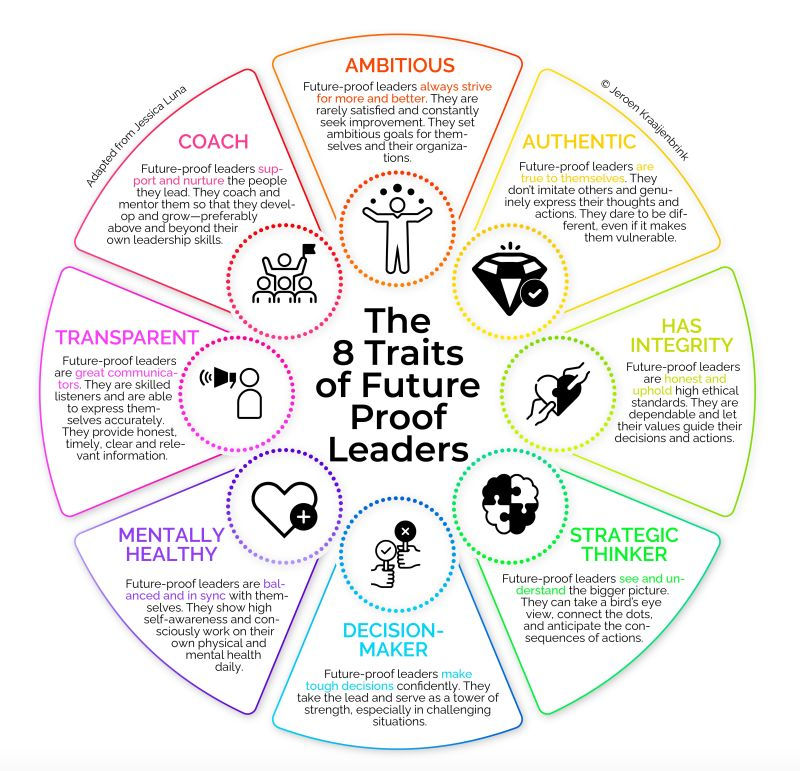
Key Traits to future proof leaders require emotional Intelligence, curiosity, critical thinking, mentally health, transparency, authenticity, integrity and motivation (Jessica Luna).
Designing Programmes That Deliver
Based on the weight of current research, effective leadership development for future-proofing should incorporate the following core design principles:
Strategic alignment: Development programmes must be anchored to the organisation's future direction, not just today's competency frameworks. L&D teams should work with HR colleagues to ensure development aligns with future talent planning needs. Leadership development is not just a training initiative for the 'now', but a core element of future-proofing the organisation (Training Journal, 2025).
Real-world application: Coaching, real-world stretch experiences, and structured feedback help leaders build the resilience, agility, and judgement needed to navigate uncertainty. These methods do more than prepare individuals, they strengthen the whole organisation.
Continuity of investment: LinkedIn Learning found that 94% of employees would stay longer at a company if it invested in their learning and development. Development is among the most cost-effective levers for reducing turnover.
Breadth of access: Leadership pipelines must emphasise breadth of experience and readiness to collaborate across functions, not just upward progression. In flatter structures, poor leadership behaviours are felt more quickly and widely. Development must cascade through every layer of the organisation, not be reserved for a chosen few (DDI, 2025).
Measurement and accountability: Deloitte's 2024 Global Human Capital Trends report found that 74% of leaders say it is important to find better ways to measure worker performance beyond traditional productivity metrics. Effective development programmes must include clear metrics, from engagement scores and retention rates to leadership pipeline depth and promotion-from-within ratios.
Conclusion: The Cost of Waiting
The organisations that will thrive in the next decade are not necessarily those with the largest budgets or the most sophisticated technology — they are those with the deepest, most adaptable leadership capacity at every level.
The evidence is unambiguous: leadership development and coaching deliver measurable returns, reduce attrition, strengthen succession pipelines, and build the organisational resilience needed to navigate an environment of continuous disruption.
Organisational resilience and future-proofing hinges on having the right people in the right roles, but now it's time to act on this realisation. ~Tacy M. Byham, PhD, CEO of DDI
The question for senior leaders and boards is no longer whether to invest in leadership development, the research has settled that debate. The question is whether your organisation is investing strategically enough, early enough, and at the right scale to be competitive for the decade ahead. Every month without a robust leadership development strategy is a month in which your future pipeline grows a little thinner, your best talent gets a little closer to the door, and your competitors gain ground.
About Racheal
Racheal is an Organisational Psychologist, executive coach and facilitator of leadership programmes world wide. The Sapient Space provides fun, fresh ways to learn, and most importantly connect and find community. We provide online and in-person leadership development solutions for individuals as well as customised programmes for organisations.
Sources & References
DDI. (2025). Global Leadership Forecast 2025. Development Dimensions International.
DDI. (2025). HR Insights Report 2025. Development Dimensions International.
Harvard Business Publishing. (2024 & 2025). Global Leadership Development Study.
Deloitte. (2025). 2025 Global Human Capital Trends. Deloitte Insights.
Deloitte. (2024). 2024 Global Human Capital Trends. Deloitte Insights.
Jessica Luna. Linkedin. 2025.
Korn Ferry. (2025). Workforce 2025 Global Insights Report.
Korn Ferry. (2016). The Self-Aware Leader.
McKinsey & Company. (2024). Scaling the 21st-Century Leadership Factory.
McKinsey & Company. (2020). Diversity Wins: How Inclusion Matters.
Gallup. (2025). State of the Global Workplace 2025.
International Coaching Federation (ICF). (2023). Global Coaching Study: Executive Summary.
World Economic Forum. (2025). Future of Jobs Report 2025.
LinkedIn Learning. (2024). Workplace Learning Report.
Torch. (2024). Navigating 2025: 5 Leadership Development Trends.
Training Journal. (2025). Build a Future-Ready Leadership Pipeline with Targeted Development.
Executive Coach College. (2025). Why Executive Coaching Became a Top Organisational Investment.
Ready for Clarity?
Most senior leaders I speak to aren't struggling with capability. They're struggling with clarity. If you're heading into Q2 feeling stuck, overwhelmed, or like you're leading on autopilot, then join our Leadership Clarity coaching session. A 90 minute one-on-one coaching session to help you gain clarity, whether it is working on creating psychological safe environments or another goal. You can book on the link below.


Comments